Eliminate Operational Friction with Sub-10ms AI Inference
Instant Intelligence for the Sovereign Enterprise.
In the high-stakes landscape of 2026, latency is the silent killer of productivity. Traditional AI architectures are bottlenecked by slow external database lookups. Okiff AI breaks the speed barrier by pre-loading your intelligence into the GPU’s immediate memory.
Our Cache-Augmented Generation (CAG) architecture delivers near-instantaneous reasoning. We bypass the delays of cloud-based retrieval, empowering real-time decision-making for regulated industries. Secure your data, accelerate your workflows, and own your intelligence without compromise.
Beyond Traditional RAG: The Speed of Context-Augmented Systems
From seconds to milliseconds: The new standard for industrial intelligence.
Traditional Retrieval-Augmented Generation (RAG) often suffers from "tribal knowledge" silos and fragmented data retrieval. This process introduces significant operational friction. The model must search through millions of document chunks for every single query.
Our solution utilizes Cache-Augmented Generation (CAG). By pre-loading your enterprise knowledge base directly into the GPU’s KV Cache, we eliminate the need for real-time data fetching. This results in generation speeds up to 40x faster than standard retrieval models.
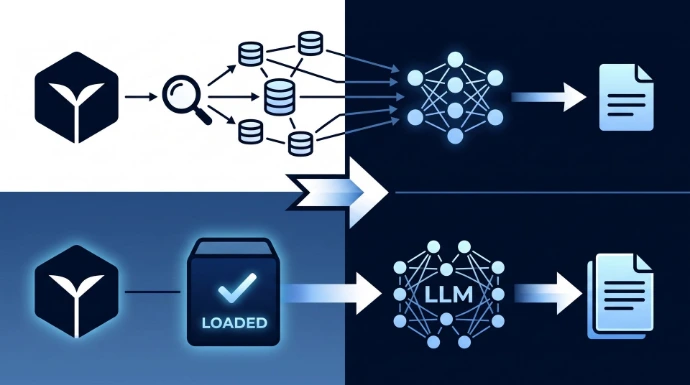
Technical Strategy Comparison: RAG vs. CAG
Feature | Retrieval-Augmented Generation (RAG) | Cache-Augmented Generation (CAG) |
|---|---|---|
Response Latency | 200ms – 2,000ms+ (Variable) | Sub-10ms (Deterministic) |
Knowledge State | Reactive (Searched on-the-fly) | Proactive (Pre-loaded in memory) |
System Complexity | High (Vector DBs, rankers, retrievers) | Low (Direct KV Cache management) |
Contextual Integrity | High risk of "Lost in the Middle" | Holistic document understanding |
Compute Cost | High per-query search overhead | Amortized one-time cache build |
Absolute Compliance in a Regulated Landscape
Unmatched speed should never come at the cost of data security
Enterprises operating in 2026 face compressed timelines for regulatory compliance. Quebec’s Law 25 and the EU AI Act require strict data residency and automated decision transparency. Traditional cloud-based AI often exposes organizations to the US CLOUD Act.
Okiff AI builds a "Data Wall" around your intelligence. By deploying via Hardware-as-a-Service (HaaS) or local nodes, your sensitive data remains within your jurisdiction. Our architecture provides a transparent citation trail, ensuring every AI response is audit-ready and defensible.
Regulatory Deadlines and Compliance Impact
Regulation | Operative Deadline | Primary Requirement | Okiff Solution |
|---|---|---|---|
Quebec Law 25 | Enforced 2024-2026 | Explicit AI transparency & PIAs | Local logs & built-in PIAs |
EU AI Act | August 2, 2026 | High-risk system logging & oversight | Traceable OKF version control |
Canada Bill C-36 | Proposed 2026 | Meaningful consent for AI logic | Plain-language AI audit trails |
GDPR | In Effect | Cross-border transfer assessments | Localized sovereign hosting |
Our sovereign stack unifies identity, data, and policy at the kernel level. This prevents data leakage while maintaining the high throughput required for social infrastructure and defense. Compliance is no longer an add-on; it is the foundation of our speed.
Knowledge as Code: The OKF Revolution
Stop re-searching. Start cross-linking your intelligence.
The primary bottleneck for AI agents is fragmented, unstructured text. Google Cloud’s Open Knowledge Format (OKF) challenges the assumption that knowledge must be re-derived on every query. OKF packages your curated content as linked Markdown files with YAML frontmatter.
By adopting OKF, your organization transforms static documentation into a traversable knowledge graph. This "LLM-Wiki" pattern allows agents to navigate your data deliberately. It ensures your intellectual property remains portable, version-controlled, and completely independent of any single AI vendor.
The Three Pillars of OKF Interoperability

Just Markdown
Content is human-readable, Git-backed, and indexable by any tool without proprietary SDKs.

Just Files
Shipping knowledge is as simple as cloning a Git repository or mounting a filesystem.

Just YAML
Structured metadata ensures your concepts are instantly queryable and filterable by AI agents.
This format reduces duplicated information and ensures agents never have to guess. By structuring content around clear concepts, we provide the "Golden Knowledge" that agents need for day-to-day operations. Knowledge management finally receives the same discipline as software development.

Industrial-Grade Hardware for Mission-Critical Speed
Elite software requires the world’s most powerful inference engines.
Sub-10ms latency is only achievable when soft-layer optimizations meet high-bandwidth memory (HBM) infrastructure. We deliver our Sovereign AI stack through pre-configured nodes that initialize automatically. This allows for near-instant access to large, complex context windows.
Our Hardware-as-a-Service (HaaS) model eliminates the high CapEx barriers of AI adoption. Whether you need on-site Edge Nodes for robotic guidance or centralized core servers for enterprise reasoning, we provide the dedicated silicon required for attention mechanism acceleration.
Latency Targets by Enterprise Use Case
Use Case | Latency Target | Why Milliseconds Matter |
|---|---|---|
Fraud Detection | < 10ms | Transaction must be scored before authorization. |
High-Speed Rejects | < 15ms | Line-speed decisions prevent production waste. |
Robotic Guidance | < 20ms | Precise vision loops require instant feedback. |
Voice AI Agents | < 200ms | Human tolerance for conversational pauses. |
Dynamic Pricing | < 100ms | Real-time page rendering blocks on pricing. |
We prioritize energy efficiency through task-specific models. This "Circadian Cycle of Calculus" redirects compute power to AI training after office hours, ensuring your usage rates exceed 85%. You get maximum performance with a reduced environmental footprint.
Inclusive Intelligence: Accessible to Everyone
Leading the standard for web usability and cognitive accessibility.
In 2026, accessibility is not just a checkbox; it is a legal and ethical requirement. Our landing pages are engineered to meet WCAG 2.2 Level AA standards. We ensure that every user, regardless of ability, can navigate our high-speed AI ecosystem.
We have eliminated tiny tap targets and hidden focus states. Every interactive element—from buttons to form fields—is designed with a minimum size of 24x24 pixels. This ensures usability on mobile devices and for users with limited motor control.
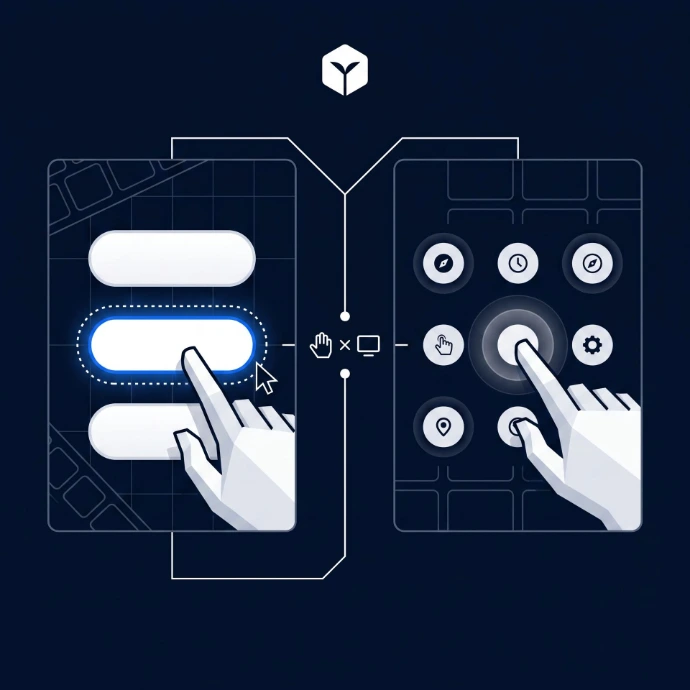
Key Accessibility Features for 2026
Focus Visibility
We use high-contrast focus indicators so keyboard users never lose their place.
Cognitive Load Reduction
Our forms utilize auto-fill and consistent help locations to reduce mental friction.
Semantic Structure
Proper H-tag hierarchy allows screen readers to interpret the page's "Accessibility Tree" accurately.
Accessible Authentication
We provide alternatives to complex puzzles or memory tests during login processes.
By adhering to "POUR" principles—Perceivable, Operable, Understandable, and Robust—we ensure our content withstands scrutiny from regulators and users alike. Your website should be a bridge to your technology, not a barrier.
FAQs (People Also Ask)
How does CAG achieve sub-10ms latency compared to RAG?
Traditional RAG retrieves data from external databases for every query, adding 200ms to 2,000ms of lag. CAG pre-loads your knowledge base into the GPU's KV Cache once, allowing the model to "remember" context instantly during inference.
What is the Open Knowledge Format (OKF) and why is it vendor-neutral?
OKF is a directory-based specification using Markdown and YAML. It is a "format, not a service," meaning your knowledge is not locked into any proprietary cloud or SDK. It can be moved across any AI framework without translation.
How does Okiff AI ensure compliance with Law 25 and the EU AI Act?
We use a "local-first" sovereign architecture. By executing AI on-premise or on sovereign cloud nodes, we keep data out of US jurisdiction (CLOUD Act risk) and provide the transparent logging required by modern privacy laws.
What is the primary operational benefit of using a "Circadian Cycle of Calculus" for compute?
It maximizes energy efficiency by redirecting compute power from inference to AI training tasks during off-peak hours, ensuring high infrastructure utilization rates of over 85%.
How does the "Data Wall" approach differ from traditional perimeter security?
Unlike traditional firewalls that protect the network edge, the Data Wall integrates security directly into the AI stack via HaaS or local nodes, ensuring data residency within specific jurisdictions and preventing unauthorized external access.
Why does the shift to OKF improve collaboration between developers and AI agents?
OKF treats knowledge as human-readable, version-controlled code, allowing developers to maintain documentation using standard Git workflows while providing AI agents with a predictable, structured navigation pattern for faster query results.
Can CAG be used for large, frequently changing datasets?
CAG is ideal for "Golden Knowledge"—stable datasets like policies, manuals, and technical docs. For massive, rapidly shifting libraries, we recommend a Hybrid Tiered approach: CAG for core identity and RAG for long-tail search.