Reclaim Your Intelligence with the Unified Sovereign Stack

Modular. Compliant. Instantaneous.
Centralized clouds pose systemic risks to data integrity and jurisdictional security in 2026. Traditional AI models create fragmented knowledge silos and enforce expensive vendor lock-in. The Unified Sovereign Stack integrates compliance directly into the software kernel.
We empower enterprises to migrate workloads to a decentralized architecture, keeping data strictly within local legal jurisdictions. Achieve sub-10ms inference speeds while maintaining total immunity from foreign extraterritorial laws like the US CLOUD Act.
Integration Without Compromise
A cohesive ecosystem designed for the periphery.
Fragmented AI tools create security gaps and performance lag. The Unified Sovereign Stack unifies infrastructure, intelligence, and surveillance into a single cohesive operating system. This architecture eliminates multi-vendor complexity, providing a turn-key solution for smart buildings and smart cities.
Technology Pillar | Functional Role | Operational Advantage |
|---|---|---|
Connected Device Distributor | AI-ready hardware supply | Peak performance at the source |
Edge AI Operator | Sovereign micro-data centers | Sub-10ms real-time processing |
Internet Access (ISP) | Secure, resilient connectivity | Control over critical data flows |
Web Marketplace | Zero-Touch SaaS deployment | One-click "Industrial App Store" |
Instant Intelligence for the Sovereign Enterprise
Moving from on-demand retrieval to instant context.
Traditional Retrieval-Augmented Generation (RAG) fetches data on-demand, introducing operational friction and significant latency. This delay is unacceptable for sectors like aerospace or Industry 4.0 where decisions must be coupled to the physical environment in milliseconds.
Okiff AI utilizes Cache-Augmented Generation (CAG) to deliver near-instantaneous reasoning. By pre-loading your knowledge base directly into the GPU’s KV Cache, we eliminate the need for real-time fetching. This results in generation speeds up to 40x faster than standard models.
Sub-10ms Latency
Deterministic response times for mission-critical actions.
Knowledge as Code
Every response is backed by a Git-tracked history for an immutable audit trail.
Explainable AI
Agents cite specific sources from the Open Knowledge Format (OKF) to explain every action.
Sovereignty by Architecture
Eliminating "SaaS Sprawl" through kernel-level control.
The Compliance Kernel unifies Identity, Data, and Policy at the software kernel level. This architecture operates independently of external authorities, preventing jurisdictional leakage. It creates an "immune local digital bubble" that isolates critical operations from external threats during outages.
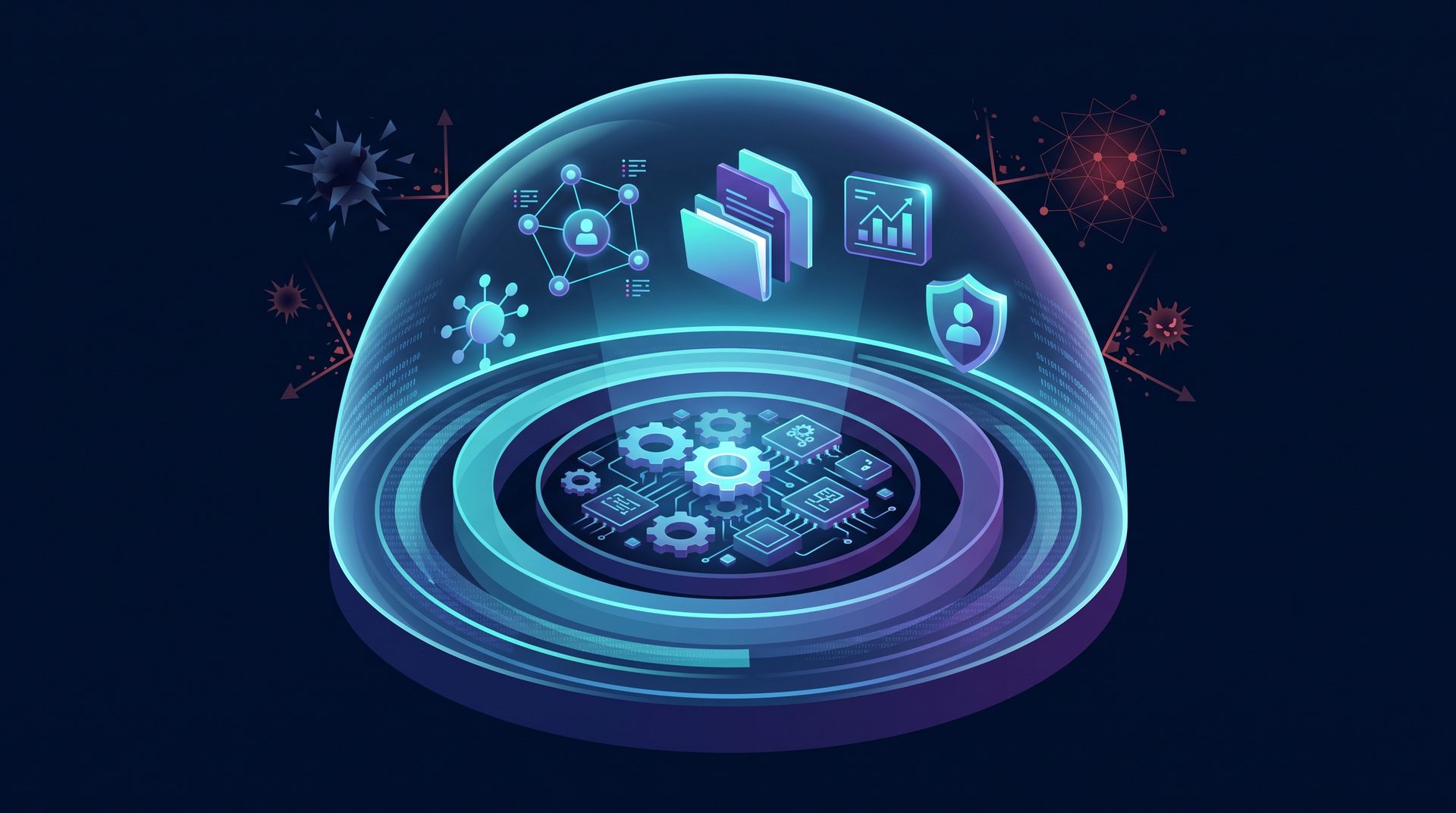
Unified Identity (IAM)
Standardized LDAP and eIDAS-compliant ledgers eliminate dependency on foreign cloud control planes.
Data Federation (MCP)
Using the Model Context Protocol to standardize data access without moving it from its original jurisdiction.
Policy-as-Code
Governance rules are converted into automated controls that monitor and regulate AI usage in real-time.
Neutralizing the US CLOUD Act
Absolute data residency for regulated sectors
Enterprises face major legal uncertainty from the extraterritorial application of foreign laws. Centralized platforms remain bound to foreign state search rules under the CLOUD Act. Okiff AI’s local processing provides natural immunity by ensuring data residency remains within domestic borders.
Our stack meets the strictest standards, including Quebec’s Law 25 and the EU AI Act. We provide automated-decision disclosure, 72-hour breach notification, and documented privacy impact assessments (PIA). This protects your organization from penalties that can reach up to $25 million.
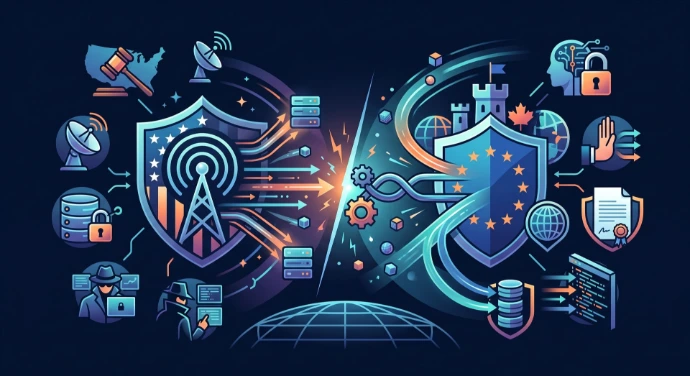
Compliance Feature | Law 25 Requirement | Okiff Sovereign Stack Support |
|---|---|---|
Data Residency | Local control mandated | Physical & logical localization |
Breach Notification | Reasonable timeframe | 72-hour automated escalation |
AI Disclosure | Plain-language disclosure | Automated AI front-desk notice |
Minor Data Protection | Parental consent required | Age-verification gate logic |
Economic Resilience Through Edge Intelligence
Reducing friction across your entire digital footprint.
Adopting the Unified Sovereign Stack offers a return on investment for edge hardware in less than 12 months. By performing algorithmic analysis locally via Okiff Reflex, raw video traffic remains confined within the company perimeter. This results in an immediate reduction of 70% to 85% on telecom bills.

Productivity Gain
Sub-10ms latency increases the daily task completion rate by 15%.

Zero Licensing Fees
Our proprietary SDI software eliminates dependencies on Cisco or VMWare.

HaaS Model
High computing costs are transitioned into clear, tax-deductible monthly outlays (OpEx).
Universal Design for Humans and Agents
Meeting WCAG Level AA and sustainability standards.
In 2026, digital accessibility is a legal requirement. We adhere to the "POUR" model (Perceivable, Operable, Understandable, Robust) for both humans and AI agents. This ensures seamless navigation for screen readers and autonomous models alike.
To maximize infrastructure ROI, we employ "Circadian Calculus". During off-office hours, 100% of compute power is redirected to intensive AI training and KV Cache compilation. This ensures your infrastructure usage rates exceed 85% while maintaining a reduced environmental footprint.
The Global Shift to Decentralized Intelligence
Capitalizing on the exponential growth of sovereign cloud.
The total addressable market (TAM) for edge computing is projected to reach $380 billion by 2028. This growth is driven by the massive adoption of AI and the convergence of 5G and IoT technologies. Okiff is positioned to capture this transition, particularly within high-stakes jurisdictions.
Market Segment | Projected CAGR (2026–2035) | Strategic Relevance |
|---|---|---|
Sovereign Edge AI | 36.9% | Real-time critical processing |
Smart Cities | 23.2% | Urban mobility and safety |
Sovereign Cloud | 24.16% | Data residency compliance |
Smart Buildings | 18.9% | Asset optimization |
Frequently Asked Questions
What is Triple Federation in AI architecture?
Triple Federation is a security framework that unifies Identity, Data (via MCP), and Policy at the software kernel. It ensures AI operations are secure, auditable, and protected from extraterritorial data requests.
How does Okiff AI address US CLOUD Act risks?
We utilize a decentralized "Continuum Edge AI" architecture that keeps data within your local jurisdiction. This physically and logically prevents unauthorized data access compelled by foreign authorities.
Why is Cache-Augmented Generation (CAG) better than RAG?
CAG eliminates the latency of retrieval by pre-loading knowledge bases directly into the GPU's KV Cache. This provides sub-10ms response times and more consistent decisions than traditional search-based RAG.
How does the stack support Quebec Law 25 compliance?
The stack integrates "Privacy by Default" through automated-decision disclosure, 72-hour breach notification logs, and minor data handling gates. It ensures all sensitive data processing remains within the required legal perimeter.
How does the Unified Sovereign Stack ensure compatibility with existing enterprise security protocols?
The stack is designed with modularity in mind, allowing it to integrate with legacy LDAP and IAM systems while layering Triple Federation security on top. This ensures that organizations can maintain their existing security posture while gaining the benefits of decentralized, kernel-level policy enforcement.
Can the Sovereign Stack be deployed in hybrid cloud environments?
Yes, the architecture supports a "Continuum Edge" model where non-sensitive tasks can still utilize public cloud resources while mission-critical intelligence and regulated data remain strictly localized within the sovereign edge nodes.
What is the typical deployment timeline for a turn-key sovereign node?
Through our Zero-Touch SaaS deployment model via the Web Marketplace, hardware can be provisioned and AI agents initialized in as little as 48 hours once the physical equipment is on-site.
How does the Open Knowledge Format (OKF) facilitate model switching?
Because OKF stores knowledge in vendor-neutral Markdown and YAML, your data is not locked into a specific LLM's proprietary vector format. You can swap reasoning models or agent frameworks by simply repointing them to the same Git-backed knowledge repository.
Does the stack provide automated auditing for AI-driven decisions?
Absolutely. Every interaction and decision made by an agent is tracked as a Git commit within the OKF framework, providing a permanent, immutable audit trail that satisfies transparency requirements under the EU AI Act and Law 25.