Sub-10ms Latency.
Zero Cloud Dependency.
Total Data Sovereignty.
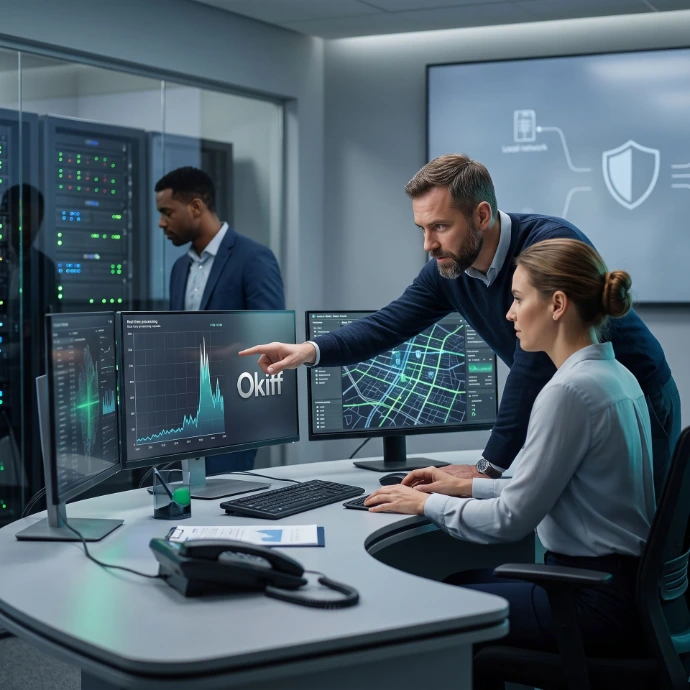
In the high-stakes landscape of 2026, latency is the silent killer of productivity. Traditional cloud AI architectures are bottlenecked by slow external database lookups and jurisdictional risks. We break the speed barrier by pre-loading intelligence directly into your GPU’s immediate memory.
Our architecture delivers near-instantaneous reasoning by bypassing cloud-based retrieval. Secure your data, accelerate workflows, and own your intelligence without compromise. Experience sub-10ms inference for real-time decision-making in Smart Cities, Industry 4.0, and Defense.
Architectural Evolution: Sub-10ms Inference with CAG
From seconds to milliseconds: The new standard for industrial intelligence
Traditional Retrieval-Augmented Generation (RAG) introduced operational friction by searching millions of data chunks for every query. This reactive process results in variable latencies that stall mission-critical edge applications. For real-time autonomous systems, 200ms is too late.
By leveraging Cache-Augmented Generation (CAG), we pre-load your enterprise knowledge base directly into the GPU’s KV Cache. This results in generation speeds up to 40x faster than standard pipelines, providing deterministic, sub-10ms response times by eliminating the "retrieval hop" entirely.
Reduction in latency
Performance Benchmark: From Retrieval to Attention
The decision to choose between RAG and CAG depends on corpus size and freshness. CAG represents the "L1 Cache" of your corporate memory, pre-marking passages for instant access.
Performance Metric | Traditional RAG | Okiff CAG Architecture |
|---|---|---|
Inference Latency | 100ms – 2,000ms+ | Sub-10ms (Deterministic) |
Knowledge State | Reactive (Searched) | Proactive (Pre-loaded) |
System Complexity | High (Vector DBs, embedding) | Low (Direct KV Cache) |
Accuracy Pattern | Fragmented context | Global context attention |
Total Data Control: Satisfying Law 25 and the EU AI Act
Unmatched speed should never come at the cost of data security
Our "Data Wall" approach ensures sensitive information remains within your physical and legal perimeter through Hardware-as-a-Service (HaaS) or local edge nodes. By processing AI on-premise, we eliminate the need for complex Transfer Impact Assessments and bypass US extraterritorial data seizure risks under the FISA Section 702 and the CLOUD Act.
Quebec Law 25
Satisfies Section 12.1 transparency mandates with automated interaction logs.
EU AI Act
Fulfills phased transparency obligations with Git-backed version control for high-risk systems.
GDPR (Article 22)
Complies with automated individual decision-making logic requirements.
The Triple Federation Framework
Okiff AI unifies three dimensions of enterprise control at the system kernel level, removing systemic vulnerabilities common in fragmented "SaaS sprawl".
Identity Federation (IAM)
Standardized LDAP/OAuth2 protocols ensure account permissions are atomically inherited across all applications, eliminating orphaned accounts.
Data Federation (MCP)
Using the Model Context Protocol (MCP) open standard, AI agents reach across siloed applications (like Odoo and Nextcloud), creating a "system of systems" where AI has a unified view of your business.
Policy Federation
The OS kernel automatically applies encryption and geographical access restrictions, creating "immune digital bubbles" during security threats.
Future-Proof Your Intelligence with OKF
Auditability by design. Portability without compromise
Don't get trapped in proprietary SDKs. Our architecture adopts OKF as its native engineering standard—a vendor-neutral, Apache-licensed specification that treats knowledge as Git-tracked code. By separating the knowledge standard (OKF) from the inference acceleration (CAG), we ensure your intelligence is as simple to audit as it is to ship.
Apache-Licensed Transparency
Built on the open standard published by Google Cloud for maximum auditability.
Just Markdown & YAML
Human-readable files that provide a clear paper trail for compliance officers without proprietary lock-in.
Native Portability
Move intelligence between LLM vendors or fine-tuning pipelines without ever rebuilding your knowledge graph.
Industrial-Grade Hardware for Mission-Critical Speed
Factory-preconfigured nodes with Zero-Touch initialization
Sub-10ms latency is achieved when soft-layer optimizations meet high-efficiency silicon. Our Edge Nodes arrive factory-preconfigured with TPM 2.0 chips for cryptographic verification. They initialize automatically upon delivery, connecting your Business Support System (BSS) to the source of data.
Hardware Category | Model Example | Technical Function | Performance Capacity |
|---|---|---|---|
Sovereign Edge Entry | Jetson Orin Nano | Small office surveillance | 4 to 8 IP cameras; baseline detection |
Industrial Perimeter | Jetson Orin NX | Manufacturing safety | 8 to 32 IP cameras; heavy AI models |
Sovereign Command | AMD EPYC 9005 | Defense / High-throughput VMS | 64+ high-definition camera streams |
Core AI Server | Precision 7960 | Enterprise RAG/CAG clusters | RTX 6000 (48GB VRAM); local LLM fine-tuning |
AI Micro Node | DGX Spark | Grace Blackwell clusters | Elite generative AI; advanced video analysis |
Reduction in bandwidth usage
Sustainable Intelligence for a Sovereign Future
Optimize your infrastructure, not just your algorithms
Sending raw data to the cloud is an operational inefficiency. For a site with 20 HD cameras, cloud streaming consumes 6 Terabytes of data monthly. By performing analysis locally via Okiff Reflex and TinyML, network costs are reduced by 70% to 85%. We bring the cognitive brain to where the data is born.
Circadian Reallocation
During office hours, resources focus on Odoo ERP; after hours, 100% of power shifts to AI training.
Energy Per Inference
We utilize task-specific models that maximize computation per unit of power.
HaaS Model
Neutralize the "CapEx Wall" with monthly operational leasing and a 3–4 year technology refresh cycle.
The Sovereign Advantage
Okiff provides a "Sovereign Moat" for your business intelligence. Unlike cloud-only providers subject to foreign legislation, we offer a "local-first" architecture that eliminates vendor lock-in and ensures total data residency. Our stack is led by PhD-level expertise in LLMs, NLP, and Computer Vision, bridging the gap between deep-tech research and operational enterprise software.
By integrating AI, IoT, and SDI into a single unified operating system, we deliver high-throughput intelligence with predictable ROI and sub-10ms performance that competitors cannot replicate.
Ready to eliminate AI friction?
Request Your Latency and Sovereignty Audit TodayFrequently Asked Questions
Why is Cache-Augmented Generation (CAG) better for Edge AI than RAG?
Traditional RAG retrieves data from external databases for every query, adding 200ms to 2,000ms of lag. CAG pre-loads your knowledge base into the GPU's KV Cache once, allowing the model to "remember" context instantly during inference. This results in sub-10ms response times, essential for smart cities and real-time industrial guidance.How does Okiff AI reduce energy consumption?
By moving inference to the source and utilizing task-specific "Derivative" models, we reduce bandwidth requirements by up to 90%. Furthermore, our "Circadian Cycle of Calculus" ensures hardware maintains an 85%+ utilization rate, repurposing nighttime power for model training instead of leaving infrastructure idle.Is this architecture compliant with global privacy laws?
Yes. Our "Continuum Edge AI" architecture is engineered for "Compliance-as-a-Service". By keeping data within your local jurisdiction, we provide the technical barriers needed to comply with Quebec’s Law 25, GDPR, and the EU AI Act while mitigating risks associated with the US CLOUD Act.What is the Open Knowledge Format (OKF) and why is it vendor-neutral?
OKF is a directory-based specification using Markdown and YAML. It is a "format, not a service," meaning your knowledge is not locked into any proprietary cloud SDK. It can be moved across any AI framework or model vendor (Hugging Face, OpenAI, Anthropic) without rebuilding your underlying architecture.How does the "Circadian Cycle of Calculus" affect hardware ROI?
It dynamically reallocates computational power based on temporal demand, maintaining GPU utilization above 85% by shifting tasks—such as shifting from Odoo ERP operations during the day to intensive model training at night—ensuring optimal return on your hardware investment.
What is the primary benefit of the "Data Wall" approach?
The Data Wall ensures that sensitive enterprise information remains strictly within your physical and legal perimeter. By processing AI on-premise, we eliminate the need for complex Transfer Impact Assessments and bypass the jurisdictional risks associated with foreign cloud data seizure.
How do you support legacy systems like Odoo within this architecture?
Through our Data Federation (MCP) layer, we connect siloed legacy applications into a unified "system of systems." This allows AI agents to securely query and interact with your existing Odoo or Nextcloud infrastructure as if it were a single, intelligent knowledge graph.
Can this architecture be deployed on existing hardware?
Yes, our "Continuum Edge AI" is hardware-agnostic where possible. We provide factory-preconfigured Sovereign Edge nodes for maximum performance, but our software stack can be deployed on existing enterprise infrastructure that meets the necessary memory and throughput specifications.