Own Your Intelligence with the Open Knowledge Format
Modular. Traceable. Interoperable.
Stop trapping your enterprise data in proprietary databases and black-box SDKs. Okiff AI leverages the Open Knowledge Format (OKF) to transform static information into a dynamic, version-controlled knowledge base that remains under your permanent control.

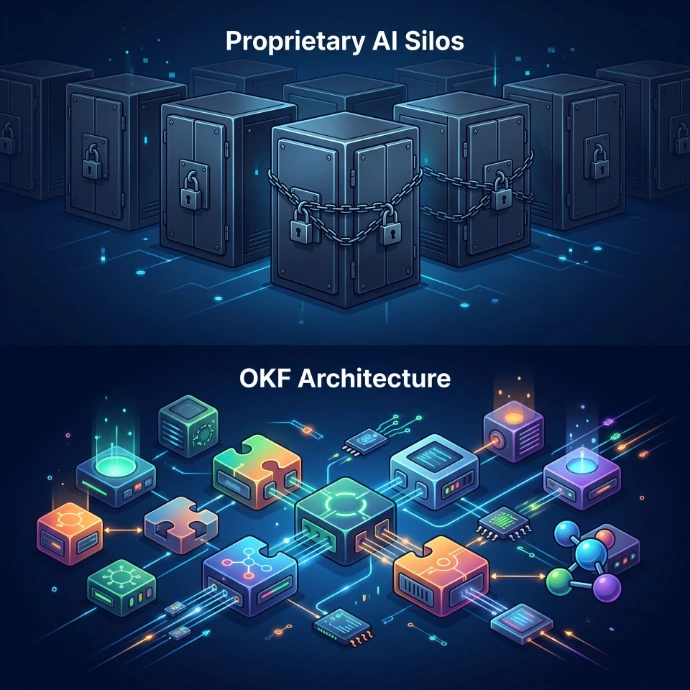
Interoperability as a Core Principle
Break free from vendor-neutrality barriers.
Traditional AI infrastructure often creates "tribal knowledge" loss and expensive vendor lock-in. OKF v0.1 is a vendor-neutral specification representing knowledge as Markdown files with YAML frontmatter. This ensures your knowledge base is modular, traceable, and ready for any model.
Modular Architecture
Each concept is stored as a single file, preventing the loss of critical enterprise context.
Version Controlled
Knowledge lives in Git alongside your code, providing an immutable audit trail of every change.
LLM Neutrality
Transition between different AI models seamlessly without the need to rebuild your entire architecture.
The Technical Edge of OKF
Turning static documents into traversable intelligence.
By treating knowledge as code, Okiff AI allows your agents to cite specific sources and explain the "why" behind every action. The directory-based specification acts as a common interchange format, eliminating the need for translation between different agent frameworks.
Comparison of Knowledge Architectures
Standard | OKF (Open Knowledge Format) | RAG (Retrieval-Augmented Generation) | Metadata Catalogs |
|---|---|---|---|
Primary Logic | Represents relationships between concepts. | Retrieves relevant text fragments. | Describes data structures and schemas. |
Core Format | Markdown + YAML Frontmatter. | Vector embeddings and similarity. | Schema metadata and SQL-based logs. |
Interface | Traversable knowledge graph. | Similarity-based search results. | Data inventory and lineage tools. |
Readability | Human and AI readable. | Primarily retrieval-oriented. | Primarily governance-oriented. |
Latency | Sub-10ms with CAG integration. | Variable (often 1s+ depending on search). | Low (but limited to metadata). |
Compliance by Design
Meeting the Rigorous Standards of 2026.
In 2026, AI transparency is not optional. The EU AI Act mandates strict data governance and traceability for high-risk systems. OKF provides a transparent, traceable version control system that ensures every AI response is audit-ready and defensible.
EU AI Act Compliance Crosswalk
EU AI Act Article | Regulatory Obligation | OKF Governance Activity |
|---|---|---|
Article 10 | Data governance and lineage tracking. | Git-backed version history of all knowledge bundles. |
Article 11 | Current technical documentation and architecture. | Self-documenting Markdown files with structured YAML. |
Article 12 | Continuous event logging and record-keeping. | Use of reserved log.md files for chronological updates. |
Article 50 | Synthetic content labeling and transparency. | Machine-readable metadata in YAML frontmatter. |
Sub-10ms Latency for the Edge
Eliminating the "Thinking" Delay in Agentic AI.
Standard Retrieval-Augmented Generation (RAG) is often too slow for real-time edge operations. Okiff AI integrates OKF with Cache-Augmented Generation (CAG) to deliver intelligence at hardware-level speeds. By pre-loading structured knowledge bundles into the model context, we eliminate the need for expensive and slow similarity searches during live queries.

Knowledge as Infrastructure
OKF turns your documentation into an active layer for AI support assistants and coding agents.

Progressive Disclosure
Agents explore information through standard Markdown links, loading only the context they need.

Edge Sovereignty
Data remains localized on air-gapped servers or sovereign cloud nodes, mitigating GDPR and US CLOUD Act risks.
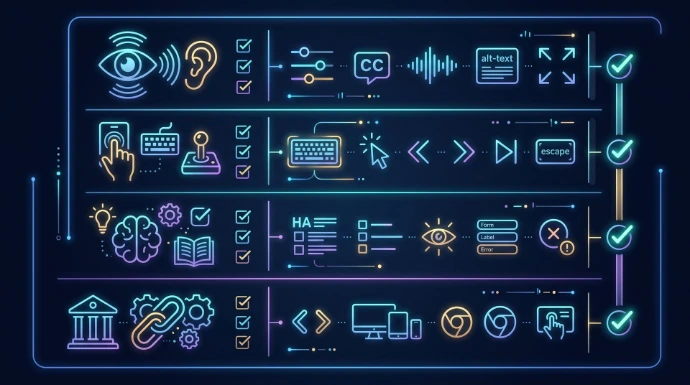
Accessibility for the Agentic Economy
Meeting WCAG and AEO Standards.
Accessibility is no longer limited to screen reader compatibility. In 2026, it includes Accessibility for AI Agents (AEO). By using semantic HTML and the Open Knowledge Format, organizations remove the "retrieval noise" that causes AI hallucinations.
WCAG and AEO Integration Table
Criterion | Accessibility Benefit (Human) | AEO Benefit (AI Agent) |
|---|---|---|
Focus Appearance (2.4.13) | Visual cues for keyboard-only users. | Allows browsing agents to track interactive states. |
Target Size (2.5.8) | Prevents "tiny tap" errors on mobile. | Ensures autonomous agents can map interactive zones. |
Consistent Help (3.2.6) | Reduces cognitive load and builds familiarity. | Provides a predictable navigation pattern for queries. |
Accessible Auth (3.3.8) | Eliminates memory tests and puzzles. | Allows agents to traverse secure gateways without friction. |
Engineered for High-Value Sales Cycles
Empowering Your GTM Teams with AI-Ready Data.
High-performing B2B websites in 2026 function as 24/7 sales assistants, answering objections before the first call. OKF ensures that your marketing assets—from case studies to whitepapers—are in a format that AI-driven ABM platforms can ingest and prioritize.
Precision Account-Based Marketing
Integrate OKF bundles with platforms like 6sense or Demandbase to detect buying intent at the account level.
Hyper-Personalized Content
Use AI-native tools like Tofu or Jasper to generate variant copy for different verticals while maintaining a unified OKF-backed brand voice.
Frictionless Conversion
Optimize for the primary conversion event (Book a Demo) with minimal form friction and direct calendar integration.
Frequently Asked Questions
What is the benefit of using OKF for my AI strategy?
The Open Knowledge Format (OKF) makes your knowledge base modular, version-controlled, and LLM-neutral. It prevents tribal knowledge loss by storing information as traversable Markdown files with YAML frontmatter. This ensures your intellectual property is portable and independent of any single AI model provider.
How does OKF improve AI auditability?
Because OKF stores knowledge in a Git-tracked history, it provides an immutable audit trail. This allows organizations to track exactly how their AI's knowledge base has evolved. Agents can cite specific sources for every decision, which is a requirement for high-risk systems under modern regulations like the EU AI Act.
Can I switch AI model providers if I use OKF?
Yes. OKF is a vendor-neutral specification. Because it standardizes how models access resources, you can transition between different AI models or agent frameworks without paying integration fees or rebuilding your entire knowledge architecture. It is a "format, not a service".
What is AEO (Accessibility for AI Agents)?
AEO refers to structuring data so that AI agents can navigate and extract it as easily as humans using assistive technologies. By using OKF and semantic HTML, organizations remove structural barriers. This increases the likelihood that AI search engines will cite your brand as a primary source in synthesized answers.
How does OKF support compliance with the EU AI Act?
OKF addresses the transparency and record-keeping requirements of Articles 11, 12, and 50 of the EU AI Act. It provides machine-readable labels for synthetic content and maintains the "technical documentation" required for high-risk AI systems in a centralized, version-controlled format.